Thursday, December 31, 2009

The Peutinger Tafel

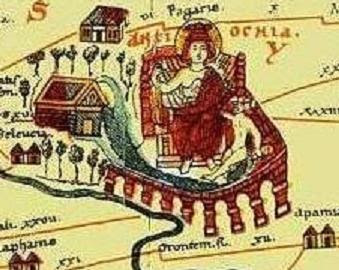
I have spoken before of the Antioch image on the Peutinger Tafel, which is one of the oldest maps extant (at least on perishable material).

In this instance I have come across a better image than I used before.

As can be seen the "lordly" figure is seated in the middle of a curling "aqueduct" which wraps itself around the river bank. One comment I read called the undressed figure a "water spirit". Though to me it seems like it might also have links to the Orontes figure that appears underfoot in the classic Tyche representation. Maybe the "aqueduct" is also not what it appears and might well be the supposed arcades along the riverbank that supported/adorned the Imperial Palace. 


A 17th Century Map/Image

This image, though grossly inacurate and fanciful, is worth showing. I actually own a copy (purchased on Ebay in the non-coloured form) which frankly is easier to discern details upon.


The artist is sometimes described as unknown and sometimes as being Agustinus Calmet, though he may be the engraver. It an copper engraving of a view of Antioch, supposedly as it was in the year 1630.

Euphorion of Chalcis

A number of names are thrown into the ring when the subject of the "first" librarian is brought up. Almost all have some relationship to Alexandria. However, a close-run candidate is the learned epic poet, Euphorion of Chalcis, who at least appears to be the first librarian at Antioch.

The life of this poet and fragments of his works were published by Augustus Meinecke in his magisterial, De Euphorionis Chalcedonsis, vita et scriptis in Analecta Alexandrina. It is frankly amazing that Meinecke found so much to say about the fellow.

Euphorion
the son of Polymnetus, was born at Chalcis in Euboea, in some versions around 274 BC. He later obtained the right of citizenship at Athens. He was the pupil of Lacydes and Prytanis in philosophy, and of Archebulos in poetry.

Antiochus III established a library in Antioch, which in 220 B.C. was placed under the care of Euphorion, then aged 50, who held the position until his death.

Euphorion principally devoted himself to epic poetry, but be also wrote elegies and epigrams. He also produced some treatises on grammar and history. He was charged with being obscure in his expressions, and with using words in a forced sense.In the following century he became a favourite model with poets such as Tibullus, Propertius, and Cornelius Callus, besides being the theme of a passing reference in Virgil (Eclogues x 50).

He wrote a book on the Isthmian Games.


Wednesday, December 2, 2009

A Sultan's Progress

I have stumbled upon an interesting text relating a progress made around his domains by the Sultan Qa'itbay. This translation and commentary was written by Henriette Devonshire in the Bulletin de l'Institut Français d'Archéologie Orientale in 1922.

In the process of this journey he visits Antioch. He was the Sultan of Egypt from 872-901 A.H. (AD 1468-1496). While Antioch is only briefly mentioned it does give some colour from a period where there are virtually no texts. Again this is in French and I shall translate it when I get some more time.

"Nous trouvames dans cette ville d'immenses et solides constructions; les murs enormes et garnis de tours vont de haut de la montagne jusqu'a l'embouchure de la riviere, de sorte que la ville entiere avec ses cultures, ses champs, ses proprietes et sa riviere se trouve a l'interieur des murailles. La ville meme contient sept collines sur une desquelles se trouve une citadelle; la longeur des murs est de 12 milles; les tours sont au nombre de 136 et les creneaux de 24,000. Antakiya fut conquise par El Malik ez Zahir Beibars; elle contient beaucoup de boutiques, des marches, et la population en est nombreuse. Mais ce sont Turcomans peu civilises et leurs maisons ont des pignons dont les toits en pente sont de bois recouvert de fascines de chaume que l'on appelle bourda. C'est la que se trouve le Sanctuaire de Sidi Djib en Nadjdjar - que Dieu nous soit propice par ses vertus! - situe entre deux larges collines a pentes douces."

A few points to note include the seemingly robust commercial sector considering that Baibars had ravaged the place only 200 years before. The seven hills are mentioned for the first time we have heard. We cannot imagine what these are. A river "inside the walls" is mentioned, presumably the Parmenios. We have what I think is the first mention I have found of the Najjar mosque.